
and orthographic mapping
SCAFFOLD
This project was developed as part of a hands-on studio focused on process, material exploration, and formal discovery. The goal was to explore how spatial relationships emerge through making—not from a plan, but from interaction with material, form, and chance.
Workshop-Based Studio Project 2023
Featured in YES Year End Show

The Process
This design process offers a way to think through material, rather than about it. By casting, cutting, revealing, and reconstructing, we begin to see how form carries traces of pressure, resistance, and time. Boundaries are no longer neutral—they swell, collapse, protrude, or yield. Interiors become legible not through drawing, but through excavation. These acts let us observe how things press outward, how voids shape solids, and how surface, texture, and depth begin to speak—long before function is ever assigned.

This process began by casting plaster around inflated balloons. Once cured and removed from the mold, the cube held hidden voids shaped by pressure and collapse.


Selected fragments were photographed and translated into digital 2D drawings, then composed into analytical collages—studying how forms relate through orientation, overlap, and shared voids.

The final collage—composed of selected fragments in deliberate orientations—mapped out relationships of contrast, repetition, and spatial tension. This composition was then reinterpreted in three dimensions, forming a scaffold that physically reconstructs the dialogue between solids and voids, structure and suspension.

Scanning: Selected fragments were scanned to capture their contours, textures, and interior shapes for further study.

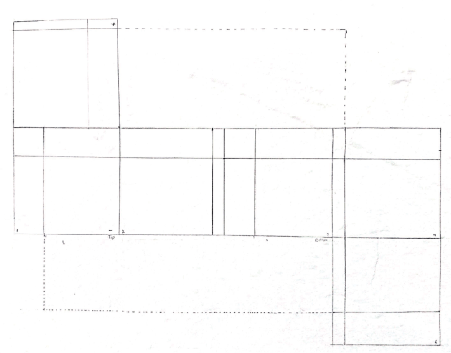


Tracing: Cuts were traced onto paper, flattening the 3D form into a 2D record of voids and edges.


Instead of using standard dowels, the vertical elements were laser-cut to create precise slots for each fragment, allowing for controlled spacing based on a measured rhythm. The intervals followed a system of doubling and tripling distances, creating a scaffold that wasn't just structural, but spatially intentional, mapping form through calibrated separation and alignment.


